


The advent of Artificial Intelligence tools, especially ChatGPT-3.5 in late 2022 triggered alarms across the world. And it wasn’t about AI taking over jobs that’re traditionally done by humans. Instead, the panic was all about fake information and plagiarized content spreading rapidly.
The probability of fake information, plagiarized content and misleading articles was widespread. That’s because almost every industry or profession worth its salt uses content in some or the other form. Regardless whether it’s used online or offline, false information and plagiarized content come packed with very high risks.
This made it imperative for organizations creating AI tools to launch resources that can effectively detect Artificial Intelligence generated content. The need to verify whether any specific content is written by humans or machines led to rapid development of AI content detectors.
Therefore, to understand their development, let’s look at some of the reasons why AI content detectors became necessary despite their inherent uselessness.
Reasons for Using AI Content Detectors
Before ChatGPT-3.5 and other AI tools appeared, content was generally written by persons having sufficient knowledge in any particular field. Additionally, these persons had excellent writing and presentation skills too. This made their content popular, both among readers and companies. As a matter of fact, content creation ranked among the highest paying jobs in the world.
Unfortunately, ChatGPT-3.5 and other similar AI resources made it easy for practically anyone to automatically generate content. These persons lacked the knowledge and nor did they have writing skills. Worse, they were unaware of how to research into various subjects. The result was that millions of persons began calling themselves as content writers. All they had to do was give specific prompts to AI tools and the content would be generated automatically.
While content writers would take a few hours on meticulous research and framing the content, those using AI could outrun them by generating it within a few seconds. Persons creating content using AI became more widespread than professional content writers. It also became easier for copycats to feign writing styles of various professional content writers. This can be done simply by asking any AI tool to analyze a writing style and later, asking it to be copied while writing.
The results were disastrous. Businesses and educational institutes as well as laypersons struggled to know what was original, research based and accurate content and how to differentiate between fake, misleading and plagiarized variants.
Eventually, Google, the largest search engine in the world, had to step in. Google modified its algorithms and created stringent rules against AI generated content to prevent free spread of fake or misleading information and plagiarized content. Educational institutes and businesses too had to tighten screws to ensure that everyone from students to employees, top execs to stakeholders presented only original content and not fake or plagiarized versions.
With increasing number of AI writing tools entering the market, it was imminent for businesses and educators to check for AI generated content. This led to the rise of AI content detectors.
Workings of AI Content Detectors
AI content detectors function like detectives examining a scene for clues. They use a combination of techniques to analyze text and determine whether it was likely written by a human or generated by AI.
Here’s how they work:
Machine Learning and Natural Language Processing (NLP)
Detectors are trained on massive amounts of human-written text and AI-generated content. NLP helps them understand the structure, grammar, and semantics of language. Through machine learning, they learn to identify patterns and characteristics that differentiate human and AI-written text
Statistical Analysis
Detectors analyze statistical properties of the text, like perplexity. Perplexity measures how AI-generated, as AI may struggle with nuanced human expression. Another metric, burstiness, examines how much the sentence structure and vocabulary vary throughout the text. Human writing tends to have a natural flow with some variation, while AI-generated content might exhibit bursts of complex sentences followed by simpler ones.
Checking Red Flags
AI content detectors look for signs common in AI-generated text, such as factual inconsistencies. AI may not have the same grasp of real-world knowledge as humans and might introduce inconsistencies.
AI-generated content may reuse phrases or sentence structures too frequently.
AI may struggle to generate truly creative ideas or unique perspectives.
AI might use awkward phrasing or vocabulary choices that wouldn’t occur naturally in human writing.
Checking with Databases
Some AI content detectors check the text against databases of known AI-generated content to identify potential matches.
It’s important to note that AI content detectors are not perfect. As AI writing tools improve, detectors constantly need to adapt. Additionally, heavily edited or paraphrased AI content can be more challenging to detect. However, they remain a valuable tool for assessing content originality and quality in our evolving digital landscape.
Best 9 AI Content Detectors
Since you’re now aware of the uses of AI content detectors, I suggest that you try them. Before using any AI content detectors, it’s important to know that some organizations actually permit a small percentage of their content to be generated by AI. This is done through company policies and would usually depend on the uses of such AI generated or partly AI generated content.
If you wish to try a superb, free AI content detector, try any of these:
1. GPTZero
GPTZero is used by millions of users worldwide. This isn’t exactly a free AI content checker or detector. Instead, you can use it free for checking only one content. GPTZero tells whether a content is original or partly generated by AI or fully AI created. However, use this AI content detector with caution since results can vary for the same content when checked again.
2. QuillBot AI Detector
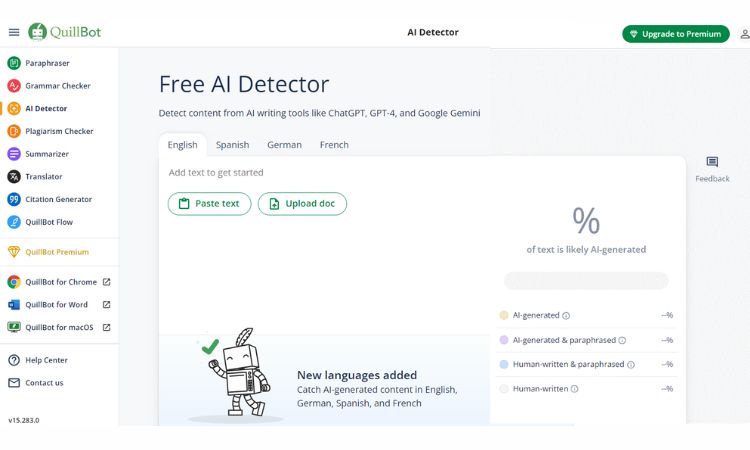
Quillbot AI Detector is a better tool for detecting AI generated content. That’s because it has the capabilities to detect rewritten content too. For example, someone might get content generated from AI and later, rewrite it to evade detection. However, Quillbot detects such paraphrasing and other common tactic.
3. Sapling Plagiarism Detector
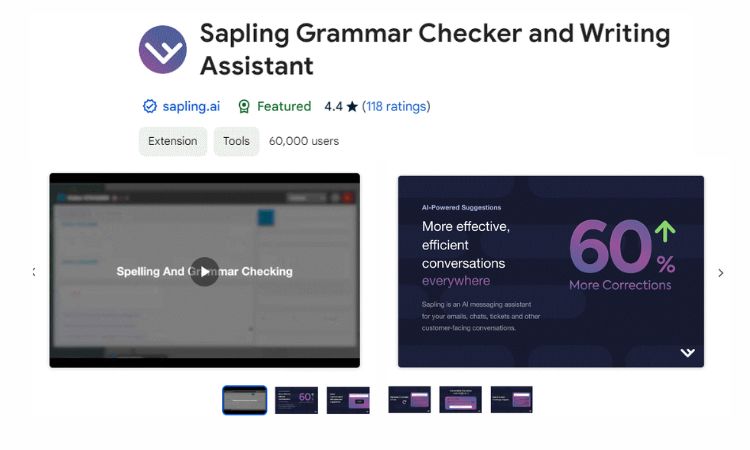
Once again, this isn’t a free resource though you can use the trial version a couple of times for checking content. Sapling is more of a plagiarism detector that uses AI. That means you can find whether someone is copying the works of another person, either in total or partly. It is incapable of detecting fake or manipulated content.
4. TraceGPT
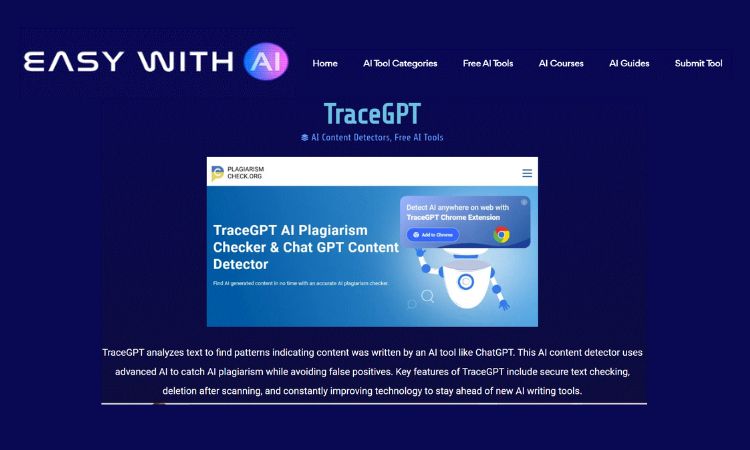
TraceGPT is so far the best AI content detector that I have found. Understandably, it does come with loads of issues. For example, when you test the same content multiple times, you might get different results. However, it is able to detect a lot of things unlike the ones I mention earlier, including heavy editing and paraphrasing. The trial version is free for single use.
5. Originality.AI
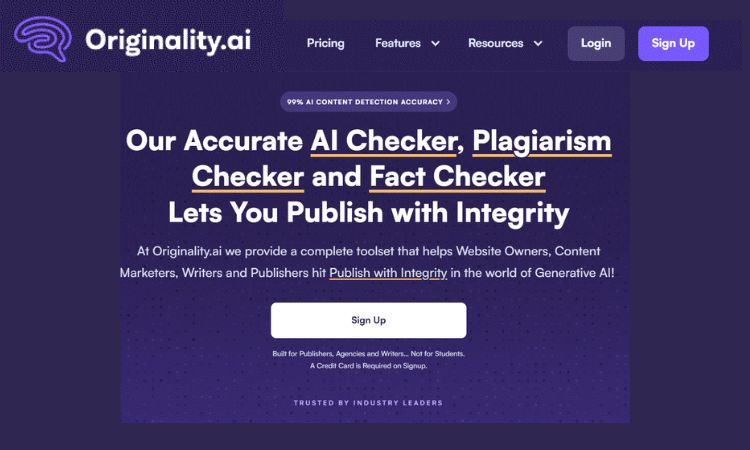
Originality.AI serves two purposes- checking for plagiarized content and checking for AI generated content, both at the same time. The trial version with basic and limited features is free for use. You can also set Originality. AI to disallow or allow AI generated content up to a certain percentage in an article or book or content. That gives you better control than other such tools.
6. Winston AI
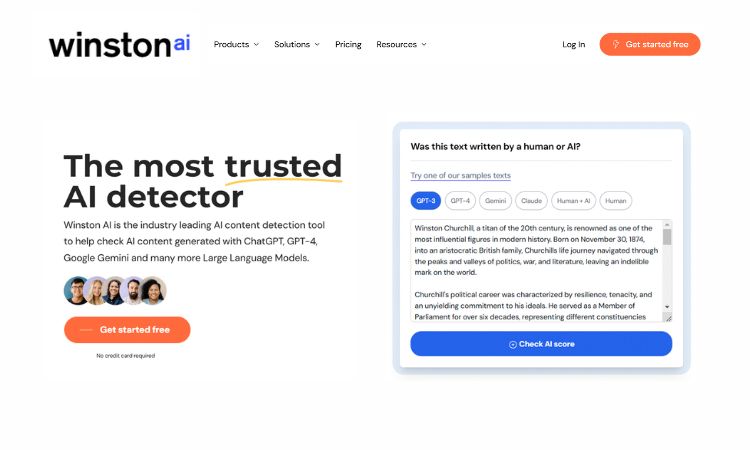
Winston AI is a top tool for detecting AI-generated content from models like ChatGPT, GPT-4, and Google Gemini. It boasts a 99.98% accuracy rate and is used by many institutions and publishers to ensure content authenticity.
The tool can identify AI-generated text, paraphrased content, and works in multiple languages, including English, French, and Spanish. Users can create a free account, paste or upload documents, and get results showing the likelihood of AI involvement and any plagiarism detected.
Winston AI also offers a Chrome extension for easy detection across the web and is designed to keep your content secure and confidential.
7. Corrector. AI
Corrector.AI is available as an app. They offer a free plan but with several limitations. This makes it ideal for non-professional use and home use only. However, it is not suited for professional purposes. Basically, Corrector.AI detects AI generated content through errors and repetitions in grammar, frequent use of transition phrases and other such parameters. This tool also has severe limitations like others.
8. Contentatscale.AI
If you’re looking for reliable and free AI content detector, try Contentatscale.AI. The free version doesn’t have limitations on frequency or number of uses.

However, the free version doesn’t offer advanced AI content detection features too. This AI content detector can prove useful to run the first or preliminary check on content. It detects plagiarism too in many cases. Results can vary.
9. Crossplag
Crossplag enables you to check plagiarism of any content across multiple sources such as thesis, researches, books, papers and more. It can’t detect AI generated content heads. Instead, it can check AI generated content has been sourced by a content generator such as Rytr.AI or ChatGPT from any known source.
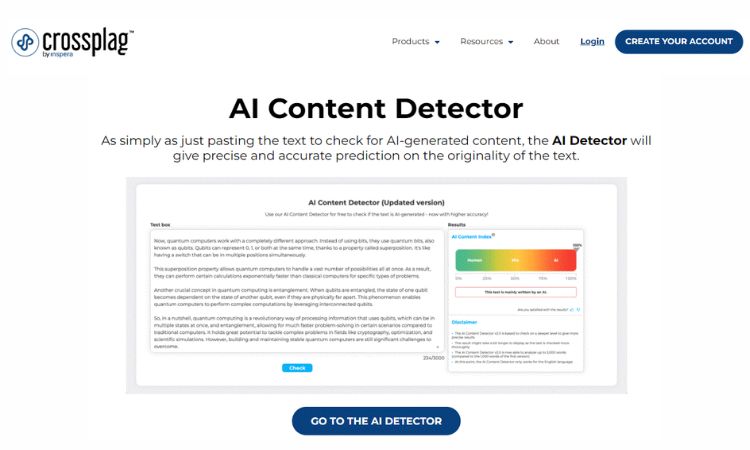
This could help you to ensure that the content you’re using doesn’t attract copyright related lawsuits that could prove expensive.
Risks of Using AI Content Detectors
You could try any of these top nine AI content detectors. At the same time, please be forewarned that using these AI content detectors isn’t without own inherent risks. Some of these detectors can falsely indicate a content as plagiarized or AI generated.
There are a several reasons why AI content detectors might mistakenly flag original human-written content as AI-generated. This can prove a major hurdle for all, content creators, students, faculty, businesses and other stakeholders.
Here’re some of the main reasons AI content detectors fail miserably.
- Pattern Matching: AI detectors work by analyzing text for patterns that are common in AI-written content. These patterns can include repetitive phrasing, overly formal language, or a lack of nuance. However, human writers can sometimes fall into these patterns too, especially in technical writing or when following specific style guides. This can lead to false positives.
- Limited Nuance: AI detectors are constantly improving, but they still struggle to understand the subtleties of human language. They might miss sarcasm, humor, or cultural references – things that come naturally to humans. If a piece of writing is particularly creative or uses unconventional language, it could be flagged as AI-generated simply because the detector doesn’t recognize the patterns.
- Evolving AI: AI detectors are trained on data sets of existing AI-generated content. If a new, more sophisticated AI model comes out, the detector might not be able to recognize its output yet. This can lead to false negatives, where the detector misses actual AI-written content.
These severe drawbacks in AI content detectors could cause your organization to lose money or lose vital talent and other resources. This is a major risk you take by using AI content detectors.
In one of my experiments, an AI content detector failed miserably. It showed that I had penned the text from a storybook by Enid Blyton as original. In another instance, it showed my original content as AI generated.
You can test drive AI content detectors and surely, you’ll find that they’re rife with problems and glitches. Even worse, AI content detectors can’t detect content that has been compiled from various sources as AI generated or plagiarized, even when using paid versions.
Conclusion
Before concluding, I will add that using AI content detectors needs you to be very knowledgeable. The first thing is that you should be aware of the writing styles of the content writer.
AI isn’t capable of copying original styles and often flags it as AI generated. In fact, some AI models try and learn from original text and later deem articles from the same writer as AI generated. Therefore, use AI content detectors and plagiarism detectors only as reference and not for final decisions.
Frequently Asked Questions
What are AI content detectors?
AI content detectors analyze the language and structure of text to see if it was written by a human or an AI. This detection helps identify low-quality content that needs editing and fact-checking before publication.
How do AI detectors work for?
AI detectors analyze text for patterns, language use, and structure, comparing these features to databases of AI-generated and human-written content. This helps determine if the text is AI-written or human-authored, ensuring high-quality, original content for better SEO and user engagement.
What are some of the best free AI content detectors?
Some of the best free AI content detectors include: GPT Zero , Quill Bot AI Detector ,Sapling Plagiarism Detector , Trace GPT, Originality.AI, CrossplagCorrector.AI, Contentatscale.AI…….etc.
Can AI detectors be wrong?
Yes, AI content detectors can be wrong. They may incorrectly label human-written content as AI-generated (false positives) or fail to detect AI-generated text that’s been edited. Constant updates are needed to improve their accuracy and reduce these errors.
How Can I Make My Essay Undetectable by AI?
To avoid AI detection, try these tips:
1.Vary sentence structure by moving clauses or shortening long sentences.
2.Use synonyms for commonly used words and phrases.
3.Add transition phrases.
4.Use contractions for a more conversational tone.


